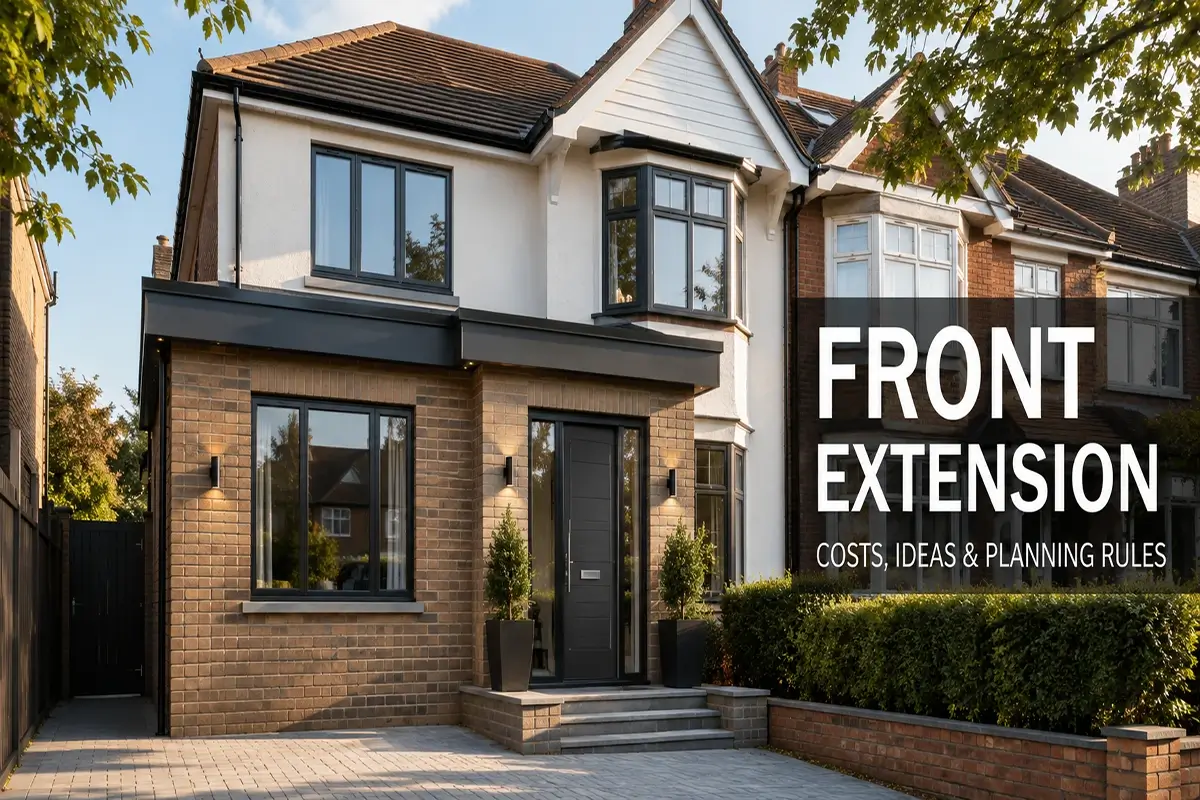
Planning a house extension is one of the best investments you can make in your home. Before breaking ground, the first question most homeowners ask is whether they need permission from your local authority at all. For most people, the answer is no. Permitted development rights allow homeowners to extend their homes without submitting a planning permission for an extension, provided the proposed extension stays within the rules set out under Town and Country Planning legislation. Knowing how big you can build before planning permission is required can save you significant time and money on your extension project. Front extensions are treated differently, so see our guide to front house extension rules.
Can I Build an Extension Without Planning Permission?
Most houses in England benefit from permitted development rights, meaning there is no need for planning permission to build a single-storey extension within defined limits. These rights apply to houses — not flats or maisonettes — and can be used without the need to apply to your local planning authority in advance. If your home is a listed building, planning permission will be required for any works regardless of size. If permitted development rights have been removed by planning conditions or an Article 4 direction, you will need to apply for planning permission in the usual way. Check this before planning your extension, as Article 4 directions are more common than many homeowners expect, particularly in conservation areas.
The Key Rules for Permitted Development
The rules governing what extension you can build without planning consent come from the Town and Country Planning (General Permitted Development) Order 2015. The central rule is that the extension must not exceed half the total area of land around the original house. The original house means the property as first built — or as it stood on 1 July 1948 — so any previous extensions already added count against your allowance. To carry out an extension under permitted development without the need for planning, your new extension must not extend beyond the rear wall of the original house beyond the permitted limits, and the materials used should match the existing house as closely as reasonably practicable.
What Size Extension Can I Build Without Planning Permission?
The size of the extension you can build under permitted development depends on your house type. The most common question we are asked is how far you can extend a house without planning permission — and the answer changes depending on whether you have a detached, semi-detached, or terraced house. Here are the limits that apply to the most common single-storey extensions.
For Single Storey Rear Extensions
A single-storey rear extension is the most common house extension in the UK. Under standard permitted development, a detached house can extend up to 4 metres beyond the rear wall of the original house, while a semi-detached house or terraced house is limited to 3 metres. Under the larger home extension scheme, these limits increase to 8 metres for detached houses and 6 metres for all other house types. The single-storey extension must be no more than 4 metres in height and must not extend beyond a side boundary. For more on how these limits affect your design, see our guide to single storey extensions.
For Single Storey Side Extensions
A single-storey side extension must be no wider than half the width of the original house. It must not front onto a highway and must not exceed 4 metres in height. Side extensions on a detached property generally have more flexibility than those on semi-detached or terraced homes, where proximity to neighbouring properties introduces additional considerations including the Party Wall etc. Act 1996, and you may need to involve a party wall surveyor.
Wraparound Extensions
A wraparound combines a rear and side extension into one. Because it crosses two permitted development categories, both sets of rules apply at the same time. The rear element must stay within the standard depth limits, and the side element must stay within half the width of the original house. Wraparounds are popular for kitchen extension projects where open-plan living is the goal. Always check with your local planning authority if you are unsure how a wraparound is assessed in your area.
PD Limits – Key Facts & Figures
A quick reference for the most common permitted development limits across house types:
- Single-storey rear — 4m (detached) / 3m (semi-detached and terraced) standard; 8m / 6m under prior approval
- Two-storey rear — maximum 3 metres beyond the rear wall, must be 7m from the rear boundary. See our guide to double storey extensions for more detail.
- Side extension — maximum half the width of the original house
- Maximum height — 4m for single storey; eaves no higher than 3m within 2m of a boundary
- Total footprint — extension must not exceed half the land area of the original house
Prior Approval (Neighbour Consultation Scheme) for Larger Rear Extensions
The larger home extension scheme lets you build within the extended limits — 8 metres for detached homes, 6 metres for all other house types — without needing planning permission. You must notify the local planning authority before starting work. Neighbours are then given 21 days to raise objections. If objections are received, the council looks at the impact on neighbouring amenity and decides whether to grant approval. Our permitted development checker can give you an early indication of how your scheme is likely to be assessed. This is a lighter process than obtaining planning permission through a full application, but it cannot be skipped. Without needing to apply for full planning permission through the standard route, prior approval is how most larger single-storey extensions in the UK are approved.
What Is the Maximum Extension Without Planning Permission in Conservation Areas?
If your home sits within a conservation area, national park, or area of outstanding natural beauty, permitted development rights are more restricted. Side extensions are generally not allowed under PD in these areas. Cladding the exterior with materials that change the appearance of the building means planning permission will be required. A home extension or conservatory to the rear may still fall within PD limits, but for homes without the need to go through the full planning permission process it is still worth confirming this with your local planning authority before work begins. Planning permission might also be required for works that would otherwise be permitted development if a condition on your title removes those rights.
What Can a House Extension Add to Your Home?
Beyond extra square footage, a house extension can add real value to a property — typically between 10 and 20 per cent depending on location, quality, and the type of space created. A well-designed kitchen extension opens up day-to-day living in a way that few other projects can match. A single-storey extension does not have to be large to make a real difference; even a modest addition that brings in natural light and connects better with the garden can change how a home feels. Good design starts with accurate house extension drawings, which set out exactly how the new space will work before any building work begins. When there is no need for planning permission, the process is faster and less uncertain, which means your project can move from design to building regulations and onto site more quickly.
Lawful Development Certificates
Even when an extension doesn’t require planning consent, having formal confirmation that your works are lawful is worth considering. A lawful development certificate from your local authority confirms that the proposed extension complies with permitted development rules. While not mandatory, it protects you when selling and gives mortgage lenders confidence. An extension doesn’t always need one, but if there is any doubt about whether the works fall within the permitted limits — for instance where previous extensions have already been added — it is sensible to apply. You can do so through the planning portal at a lower cost than a full planning application.
Common Extension Planning Permission Pitfalls
Even when carrying out a house extension under permitted development without the need for planning, there are several issues that can cause problems. Previous extensions already built reduce your remaining permitted development allowance — always check what was there before you bought. It is also a common mistake to assume PD rights have not been removed; always verify with the council before starting. Planning permission and building regulation drawings are entirely separate — every extension project still needs building regulations approval even when you don’t need planning permission. If your extension is within 3 metres of a neighbour’s foundation or adjoins a shared wall, the party wall act 3 metre rule applies regardless of whether UK planning consent is needed.
How Do I Find Out If I Need Planning Permission?
The simplest way to start is to use the interactive tools on the planning portal, which guide you through the rules based on your house type and what you are proposing. Our planning application checker is a quick way to get an initial steer before speaking to anyone. Your local planning authority also offers pre-application advice. For anything borderline, engaging a chartered architectural technologist early means you can make sure your extension is designed to comply from the outset — and that the extension is safe, meets building regulations, and is built to last. For straightforward single-storey extensions in the UK where permitted development clearly applies, many homeowners proceed with confidence once they have confirmed the position with their designer. Obtaining planning permission is only necessary when the works fall outside PD limits or where rights have been removed.
FAQs: Extensions Without Planning Permission
What size extension can I build without planning permission?
Up to 4 metres for a detached house and 3 metres for a semi-detached or terraced house under standard permitted development. Under prior approval, these limits extend to 8 metres and 6 metres respectively. You don’t need planning permission provided you stay within these limits and meet the other permitted development criteria.
How far can I extend my house without planning permission?
For a single-storey rear extension, up to 8 metres beyond the rear wall of a detached property under the larger home extension scheme, or 4 metres under standard permitted development. For semi-detached and terraced houses the limits are 6 metres and 3 metres respectively.
Can I build a 3-metre extension without planning permission?
Yes. A 3-metre single-storey extension falls within the standard permitted development limit for a semi-detached or terraced house, and well within the limit for a detached house. Planning permission will be required only if your PD rights have been removed or the extension doesn’t meet the other criteria.
What are the permitted development rules for different types of extensions?
The rules vary by house type. Detached houses have the most generous limits, while semi-detached and terraced homes are more restricted on depth and side extensions. Conservation area homes face additional constraints. The planning portal sets out the full rules for each house type.
How can I find out if my extension needs planning permission?
Use the planning portal’s permitted development checker or speak directly to your local planning authority. An architectural technologist can advise during the design stage. Planning permission might be needed even for modest works if your PD rights have been removed, so it is always worth checking early. Obtaining planning permission is straightforward when required — but confirming whether you need it in the first place should always be the first step.
Do I still need building regulations approval for an extension built under permitted development?
Yes. Planning permission and building regulations are entirely separate. Every house extension project, regardless of whether planning permission is required, must comply with building regulations covering structure, fire safety, insulation, ventilation, and drainage.
What is the Neighbour Consultation Scheme or Prior Approval for larger extensions?
It is the process that allows homeowners to carry out a single-storey extension under permitted development without the need for full planning permission beyond the standard limits — 8 metres for detached houses and 6 metres for other house types — provided neighbours are notified and raise no valid objections within the 21-day consultation period.