Extending the front of a house is one of the most misunderstood projects in UK home improvement, and most homeowners assume permitted development rights for householders will cover them — which, in the majority of cases, is mistaken. Work that pushes beyond the front elevation of your property almost always falls outside what you can build without planning approval. This complete guide sets out the house extension rules and planning regulations you need to understand when deciding whether you need planning permission for an extension to the front of your home.
What is a front house extension?
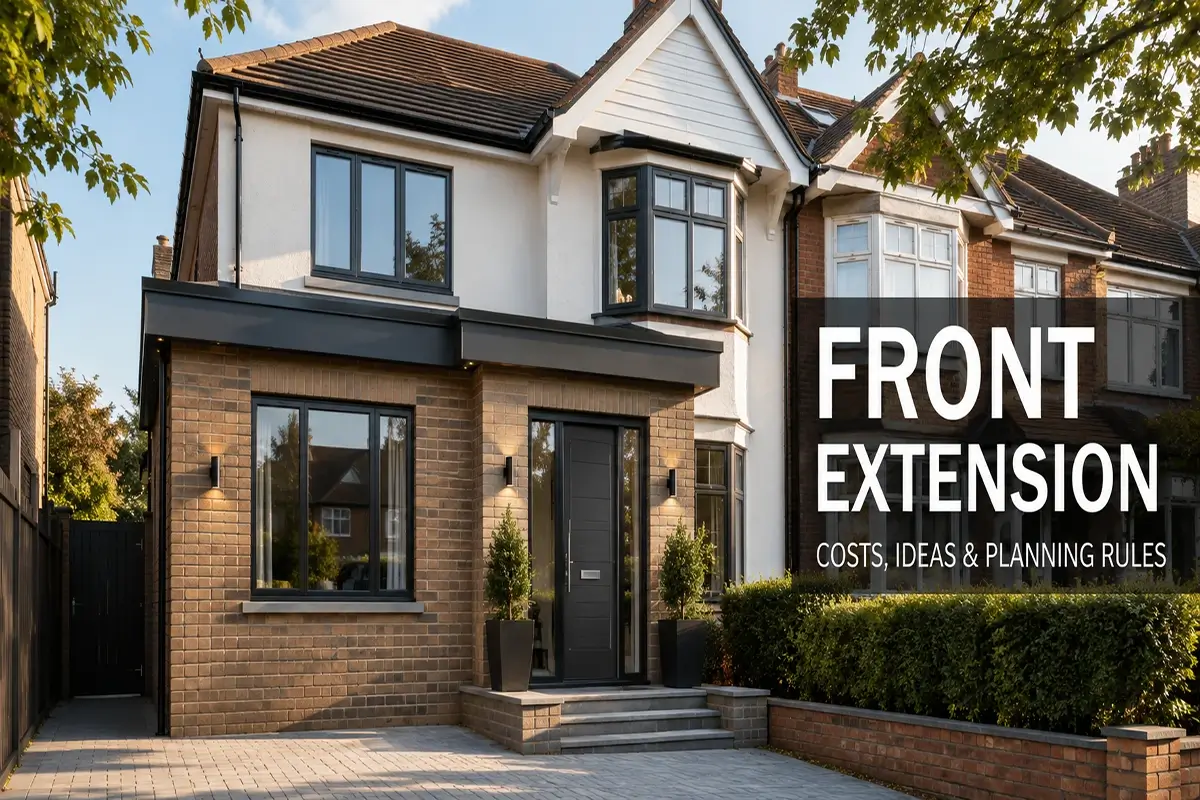
A front house extension is any building work that adds enclosed floor space beyond the existing front of a house, typically the wall facing the street. The form it takes varies considerably: building regulation drawings for a porch, a single-storey bay or study, a two-storey extension above a garage, a front conservatory, or wraparound extension drawings covering front and side additions in a single composition. Each of these alters the principal elevation of the original building.
What are the benefits of a front house extension?
A well-designed home extension at the front can add genuine value, transform the way your living spaces work, and lift kerb appeal. The aesthetic appeal of a coordinated front elevation plays a significant role in enhancing your home, and new construction allows current standards of energy efficiency to be specified into the walls, roof and glazing from the outset.
Factors to Consider Before Extending the Front of your Property
Sensible planning begins with five questions. What type of property do you have — detached house, semi-detached, terrace, or flat? When was it built, and has a previous owner already used some of the allowance? Anything built before July 1948 has its original house footprint fixed at that date. Is the property a listed building, situated in a conservation area, or subject to an Article 4 direction? How does the proposed extension relate to the highway and to the neighbour’s windows? And does the realistic budget accommodate professional fees, planning application costs, and building control alongside construction itself?
Regulations and Permissions
Overview of Planning Permission and Building Regulations
Two separate regulatory regimes apply to extending a house in the UK. Planning permission deals with whether the proposed development is acceptable in principle, considering scale, design, character and amenity. The planning regulations also capture changes of use — a garage conversion, for example, which frequently coincides with a front extension. Building regulation drawings for extensions are a separate part of the process, demonstrating how the construction will comply with structural, fire, thermal and ventilation standards. Both planning and building regulation requirements must be addressed before the completed work can be signed off.
Local Authority and Their Role in the Process
Your local planning authority decides whether a proposed extension is acceptable, applies the relevant development rules, consults neighbours, and either grants or refuses planning approval. The planning department also issues Lawful Development Certificates where work is genuinely permitted development. Building control operates in parallel, either through the local authority or a registered building control approver.
Why should you extend the front of your house?
Increased house value
A thoughtful front extension can add significant value to a property, particularly where it creates useful additional accommodation and improves the appearance of the house. Additional square footage at the front of a house — particularly where it creates a proper entrance or downstairs WC — can be an attractive improvement for future buyers.
More convenient for you
Pushing the frontage forward by even a metre can transform a cramped vestibule into a useful entry hall with storage and clear sightlines through to the rest of the house.
More room, less cost
Compared with moving, even a substantial front extension may be more economical once stamp duty, professional fees and the disruption involved in relocating are properly taken into account.
How much does an architect charge?
Architectural fees for an extension generally fall into two structures. Smaller projects are typically priced as fixed fees of £2,500 to £8,000. Larger schemes are usually charged as 7 to 15 per cent of construction cost, broken down across RIBA work stages. The agreed scope may include planning drawings, the planning application, building regulations drawings, and structural coordination.
Planning Permission
Front extensions almost always require planning permission. The permitted development rights for householders apply to houses but exclude any enlargement that extends beyond a wall forming the principal elevation of the original house. Anything larger than a porch — a study, a bay, a front conservatory, or a two-storey front extension — will normally require a planning application.
How much can I extend my house with planning?
With full planning permission there is no fixed dimensional limit, because each application is determined on its individual merits. Officers consider the established building line, the height and bulk of the proposed extension, the impact on amenity, and the materials used. A scheme that pulls forward in line with neighbouring frontages has a considerably stronger chance of securing planning permission than one that breaks the established streetscape.
Extending the Front in Conservation Areas
Conservation areas attract tighter controls. Permitted development may be reduced, materials and detailing are scrutinised more closely, and the resulting design must preserve or enhance the character of the area. Any alteration affecting the special architectural or historic interest of a listed building may also require Listed Building Consent in addition to planning permission.
Special Cases and Considerations
Dealing with Substantial Distance Extensions
Where a front extension projects forward by a substantial distance or breaks the building line, expect a more detailed assessment. Officers may require elevation drawings, sections demonstrating that daylight to the neighbour’s windows is not unduly affected, and a design and access statement explaining the design and planning rationale.
How far can you extend without planning permission?
For the front of a house, not far at all. A house extension without planning permission may be possible at the rear or side under permitted development rights, but the position at the front is considerably tighter. You cannot construct a single-storey extension forward of the principal elevation under permitted development. At the rear, single-storey extension design and drawings may cover extensions of up to 4 metres for a detached house or 3 metres for other houses under standard permitted development limits, with larger projections potentially available through prior approval, subject to conditions. None of these provisions apply to the front. An outbuilding situated in the front garden similarly falls outside the standard outbuilding allowance where it would be forward of the principal elevation and will normally require planning permission.
Permitted development for front extensions
The principal available route is the porch allowance under Class D. A porch can qualify as permitted development provided the external ground area is no more than 3 square metres, no part exceeds 3 metres above ground level, and no part is within 2 metres of a boundary with a highway. Article 4 directions can remove permitted development rights in specific areas. You can sense-check your own property using our permitted development checker. The 1.7-metre rule governing certain upper-floor side windows under Class A does not apply directly to front extensions but can become relevant on schemes that combine front and side alterations.
Building regulations for front extensions
Building control drawings will normally be required for a front extension. The regulations involved typically include Part A for structure, Part B for fire safety, Part C for moisture resistance, Part F for ventilation, Part K for protection from falling, Part L for energy efficiency, Part M for access and Part Q for security. The applicable requirements will depend on the design and use of the extension. Where the extension affects a shared boundary, a party wall agreement under the Party Wall etc. Act 1996 may be required, and the relevant party wall notices should be served before notifiable building work commences.
What is the ’45-degree’ rule?
The 45-degree rule is an assessment tool used by many local planning authorities to evaluate potential loss of daylight or outlook. In plan, a line may be drawn at 45 degrees from the centre of the nearest habitable room window on the neighbouring property. Some councils also apply a similar assessment in elevation. If the proposed extension crosses the relevant reference line, officers may scrutinise the impact on neighbouring amenity and could require the scheme to be reduced in scale.
How much does a house front extension cost?
For 2026, front extension build costs can vary significantly according to location, specification, access and structural complexity. Typical allowances may fall between £2,400 and £3,500 per square metre outside London, and between £2,800 and £4,800 per square metre inside the M25. A two-storey front extension over an existing garage costs more in absolute terms but can be more efficient per square metre. Allowances should also be made for professional fees, planning fees, building control and a contingency of at least 10 per cent.
What Are Planning Rules for Extensions?
The applicable planning rules depend on property type, location, and the scale of the proposal. Front extensions generally require planning permission; rear extensions and side extensions can sometimes be built under permitted development; flats and maisonettes do not benefit from the same householder permitted development rights for extensions; and conservation areas, listed buildings and Article 4 directions can introduce further restrictions. The detailed rules are contained within the General Permitted Development Order and the relevant local planning policies.
What is the neighbour consultation scheme?
The neighbour consultation scheme applies to larger single-storey rear extensions only, not front extensions. It can permit projections beyond the original rear wall of up to 6 metres for semi-detached and terraced houses, or up to 8 metres for a detached house, subject to the prior approval process and the applicable conditions. No equivalent neighbour consultation scheme exists for front extensions, which will normally require a full planning application.
Unlock the potential of the space at the front of your home
The rules around extending the front of a house are stricter than for other elevations, but they are navigable with the right professional support. Through considered design and a properly coordinated package of house extension drawings, a front extension can unlock underused space and deliver a genuine transformation. AC Design Solution handles front, side and rear extensions across London and the South East, from feasibility and planning through to building control approval. Request a quick quote to get started.