
Architectural services · MCIAT qualified
Building regulation
drawings.
From £600 · Building Control submission support
Fast, fixed-price building regulation drawings for extensions, loft conversions, garage conversions and new builds.
We provide fast, affordable building control drawings prepared by MCIAT qualified professionals.

The short answer
What are building regulation drawings?
Building regulation drawings are the technical drawings that show how your project will meet the Building Regulations. They are sometimes called building control drawings, after the body that checks them.
Planning drawings show what a building will look like. Building regulation drawings show how it will be built — floor plans, sections and construction details carrying the structure, insulation, ventilation, drainage and fire safety information Building Control needs before it will approve the work.
- When they are neededMost extensions, loft conversions, garage conversions and structural alterations — whether or not planning permission was required. The two are separate consents.
- Cost and turnaroundFrom £600 for a domestic extension, typically five to ten working days.
- SubmissionWe handle the Building Control submission, so the drawings your builder works from are the drawings that were approved.
From approval to construction
Building Regulation Drawings That Get Building Control Approval
This is the standard of every drawing we create: professional, fully compliant, and coordinated around your specific building rather than added as standard notes to planning drawings.
Prepared properly
MCIAT-qualified professionals
Your package is developed by people trained to turn design intent into technical information.
A clear programme
Typically 5–10 working days
Once the required information is available, we confirm the programme and keep the package moving.
Fewer gaps on site
One coordinated package
Architecture, structure and building services are considered together—not left for your builder to untangle.
Your drawing package
What’s included.
Building regulation drawings prepared for building control review and direct use on site. Plans, sections, construction details, insulation, fire safety, drainage and structural coordination depending on what your project needs.
Plans, Sections & Elevations
Existing and proposed floor plans, elevations and building sections prepared to show the layout, construction and key compliance information.
Construction Details
Wall, floor, roof and foundation build-ups with practical construction notes your builder can use directly on site.
Insulation & Part L Details
Thermal performance information, insulation build-ups and energy-related details included where required for building control review.
Fire Safety Information
Fire safety notes, escape route information and relevant Part B considerations included where they apply to your project.
Ventilation, Drainage & Services
Ventilation, drainage, waste and service information added where required so building control and your builder have a clearer package.
Submission & Coordination
We submit your drawings to building control and coordinate with structural engineers or approved inspectors where required. Building control fees are charged separately.
What it costs
Building regulation drawing costs.
Final fees depend on the building and scope. We confirm what your project actually needs before work starts.
Basic building control drawings
Our basic building control drawings package uses standard construction notes and details, suited to straightforward projects where the standard build-ups apply cleanly to the property.
Full construction drawings
Our full construction drawings package goes further. Structural and MEP design are carried out in-house rather than handed to a separate consultant working from a 2D CAD export, and every discipline is coordinated in BIM with clash detection run across the model before the drawings are issued.
Single Storey Detail drawings
Technical drawing package for single storey extensions, including key construction details, wall types, sections and building control information.
Loft Conversion
Technical drawing package for loft conversions, including sections, wall types, fire safety information and key construction details.
Double Storey Detail Drawings
Technical drawing package for double storey extensions, including additional sections, fire safety information, setting-out details and structural engineer coordination where required.
Basements
Individual quote for basement projects, including construction drawings, fire strategy information, wall and floor build-ups, setting-out details and coordination for complex works.
Building Control fees are charged separately.
We will confirm the scope of work before you appoint us.
What proper construction drawings look like.
Our drawings do not stop at showing what the completed building should look like. Critical construction junctions are developed at a scale that allows the materials, dimensions and interfaces to be understood before the work is built.

Part E Separating Wall Redesign
Part E separating wall redesign. Project-specific 1:5 construction detail coordinating the block density, insulated cavity, wall ties, internal finishes and discontinuous ground floors required to control acoustic bridging between the dwellings.
Project example 01 – On a recent pair of new build dwellings, the separating wall specification had to be changed because the original construction did not provide the required Part E acoustic solution. The revised construction used two 140mm leaves of solid lightweight aggregate blockwork, block density restricted to 1350–1600kg/m³, a continuous 75mm cavity fully filled with masonry party wall insulation, Type A butterfly ties, and minimum 10kg/m² gypsum-based board finishes to both faces. The beam and block ground floors were detailed so they remained separate between the two dwellings rather than bridging the cavity.
New Build Level Threshold Detail
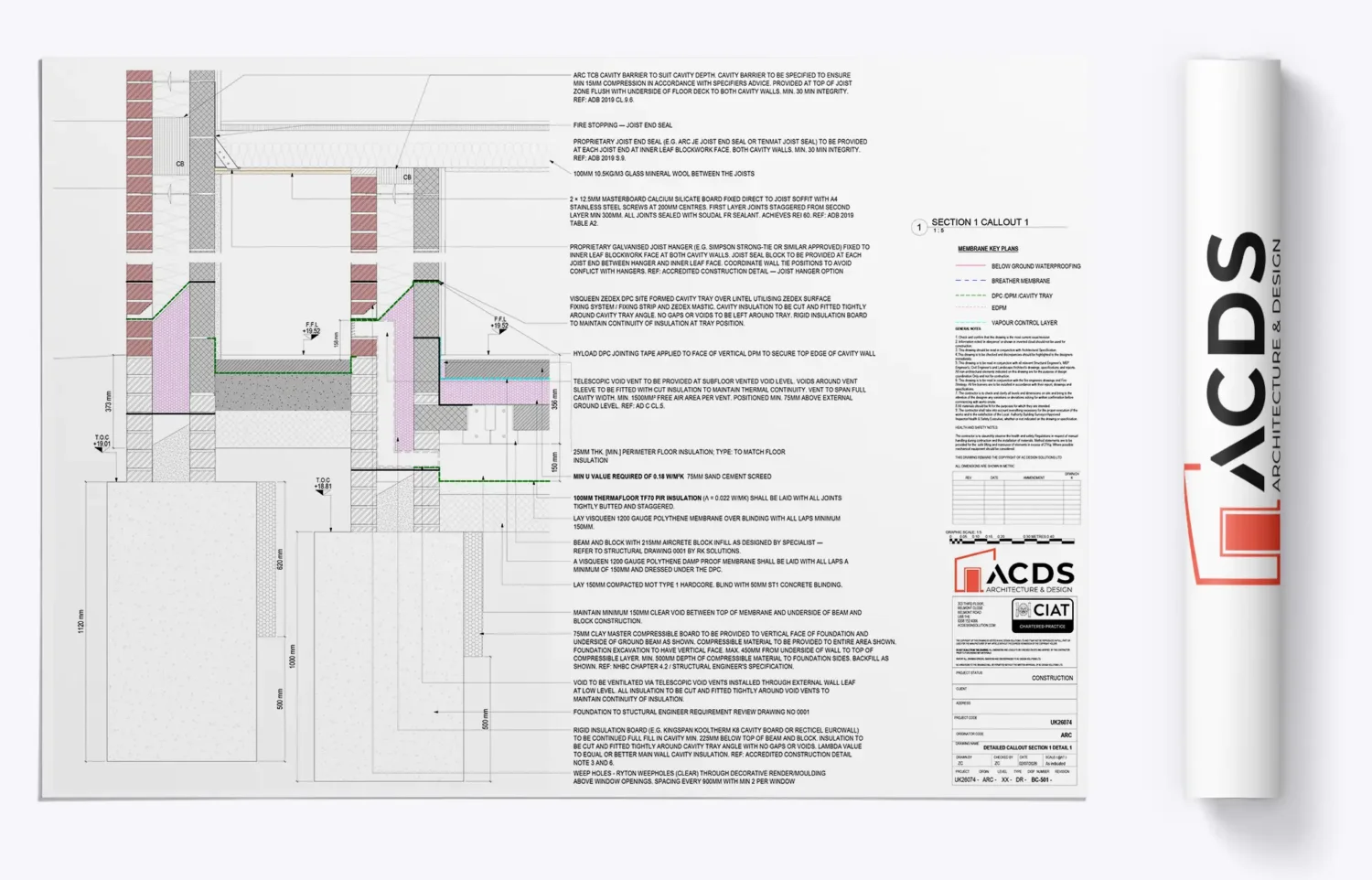
New build level access threshold. Project-specific 1:5 section coordinating internal and external levels, threshold drainage, damp-proofing, cavity insulation, beam and block flooring and the substructure.
Project example 02- A level access threshold appears simple on plan, but the detail must resolve the relationship between finished floor levels, external ground, drainage, damp-proofing, cavity insulation and the beam and block floor construction. The junction was developed at 1:5 so each interface could be checked before construction.
CLIENT FEEDBACK
Loved by homeowners and builders.Trusted across every detail.

“Excellent service! Very professional and punctual . Competitive price.”

“We used AC Design Solution for planning permission on a single storey extension and loft conversion, plus the building regulation drawings, structural calculations, and party wall surveying. They handled the whole process well and kept us updated throughout, which made things a lot less stressful than we expected. The drawings and structural work were solid, and the party wall side went smoothly too. Would recommend them to anyone needing help with planning and building regs.”

“I had an issue on site that required appointing a Party Wall Surveyor. My architect recommended Zubear from AC Design Solution, who I must say is extremely experienced and kept me updated throughout. We faced a challenging experience with the council and their surveyor, but Zubear overcame the issues, allowing me to get my Party Wall matters sorted out.”

“AC Design Solutions were fantastic in getting the job done promptly and in a professional manner. They also gave us helpful advice which assisted in our decision making with other aspects of the building works. I would highly recommend them.”

“Very supportive and helpful. Very fast response as well! Highly recommend”

Your project
Building regulation drawings by project type.
Loft Conversion drawings
The staircase is where most loft conversions get caught out. The normal target is 2m clear headroom, and if it isn’t modelled and structurally coordinated early, the layout can fall below that and need redesigning, we’ve taken over projects where a previous designer made exactly this mistake. The second recurring issue is dormer cheeks close to a party wall boundary that aren’t specified to achieve REI60 fire resistance, which building control commonly queries. Our loft conversion drawings are coordinated to catch both before submission.
Garage and Property Conversion Drawings
Garage and flat conversions live or die on the small details. On a recent garage conversion, building control queried the exact jointing tape between cavity insulation boards, the cross-ventilation route to the suspended floor plus mechanical extract at 60 l/s from the kitchen (30 l/s next to the hob), the drainage standard against BS EN 12056-2, the safety glazing spec against BS EN 12600, and the door U-value, all specific to that property, none of it answerable from a templated drawing set. We prepare practical packages covering structure, insulation, ventilation, fire safety and drainage where required.
New Build Drawing
The recurring issue on new build flats is Robust Details not followed properly, and fire stopping between separating walls left undetailed, both of which building control picks up. We’ve also hit Part E problems where the initial lightweight-block spec for a separating wall didn’t align with the required acoustic construction, see the separating wall example below for how we resolved that on a recent pair of new build dwellings. We prepare clear drawings for building control review and for contractors to price accurately, covering foundations, structure, walls, floors, insulation, ventilation, drainage and fire safety.
Single Storey Extension Drawings
A single storey extension is one of the most common home improvement projects requiring building regulations approval. We prepare technical drawings for kitchen extensions, rear extensions and side extensions, including floor plans, sections, construction details, insulation, drainage, ventilation and structural coordination where required. Our drawings give your builder clear information before work starts and provide building control with the details needed to assess the project, see our single storey extension design services for more detail.
Double Storey Extension Drawings
Double storey extensions need more detailed technical drawings than single storey work for three specific reasons. The additional floor adds real loading onto the existing foundations, so structural calculations need to confirm they can take it rather than assuming they can. Fire separation between floors has to meet Part B, which means fire-rated floor construction and escape routes get checked in a way that doesn’t apply to a single storey box. And because the extra height usually brings the new wall closer to or onto a boundary, party wall matters come up on two-storey extensions far more often than on single storey ones. We prepare building regulation drawings and construction details for two-storey extensions, helping contractors price the work accurately and giving building control a clear package for review. For more detail, see our double storey extension design services.
Built around real projects
Relevant project evidence.

2-4 Mill Street LU1
View project
54A Church Road, Richmond — Rear and Side Extension
View project
7 New Apartments Hounslow Isleworth Planning Permission
View project
Akenside Road, Hampstead
View projectPlanning Drawings vs Building Regulations Drawings

Planning drawings
Planning permission drawings focus on visual impact. They show the overall design of your project.

Building regulations drawings
Building regulations drawings are technical documents. They show how the work will be built safely and how the project will meet required standards. They can include construction notes, floor plans, sections, insulation details, drainage information and structural coordination where required.
Building Regulations Explained
What are Building Regulations?
Building regulations set minimum standards for health, safety, welfare, accessibility and energy efficiency.
They apply to most domestic building work. This includes extensions, conversions, and new builds. Every homeowner doing construction work needs to follow these regulations and relevant approved documents.

What are Building Control Drawings?
Building control drawings are construction drawings, not architectural drawings with extra labels attached. We regularly review files from other designers where solid architectural drawings have a set of templated details bolted on and called building control drawings. That’s not detailed drawings.
Every house is different: wall build-ups, structural connections, proximity to neighbouring properties, whether a party wall needs upgrading to 60 minutes fire resistance. A proper set of building control drawings includes sectional drawings taken from that specific building, showing the correct floor levels, heights and build-ups for that house, not a generic detail sheet reused across jobs.
At AC Design Solution, our MCIAT qualified technologists work through the sections and details for your property specifically.

What Happens After We Submit Your Drawings?
Review
Once your drawings are submitted, the application is validated and building control begins reviewing the plans. If they have technical queries, these are sent to us and we issue revised information where required. Building control then produces an approval, conditional approval or rejection notice.
Decision & inspections
For a full plans application, the standard decision period is five weeks, extendable to two months if you agree to the extension. A building notice doesn’t provide the same formal plan approval upfront, but work can normally begin two days after submission. Once construction starts, your contractor notifies building control, who attend the relevant inspection stages on site.
Completion
Certificates and final compliance information are issued once building control is satisfied the completed work meets the regulations.
Are Building Regulation Drawings Enough to Build From?
We offer two levels of building regulation drawings, and which one you need depends on the project.
Basic Building Control Drawings
Standard construction notes and typical build-ups, applied where they genuinely suit the property. Enough for building control to assess compliance and for your builder to price and build from.
Full Construction Drawings
Junctions developed for your building rather than picked from a library, drawn at a scale where the materials, dimensions and interfaces can actually be read. Where a standard build-up will not work — a separating wall that has to meet Part E, a level threshold resolving floor levels, drainage and damp-proofing at once — the detail is redesigned rather than annotated.
For anything with real complexity, structural alterations, multiple disciplines, or junctions specific to that building, this is the package that gives the contractor genuinely buildable information rather than compliance notes alone.
Common questions
Before you begin.
When Are Building Regulations Required for My Project?
Building regulations approval is required for many types of domestic building work, including extensions, loft conversions, garage conversions, structural alterations, new builds, major renovations and work affecting fire safety, drainage, insulation or structural stability.
Some minor works may be exempt or handled through competent person schemes, but it is always best to check before work starts. We can review your project and advise whether building regulation drawings are likely to be required.
Do I Need Building Regulation Drawings for an Extension?
Yes, most house extensions need building regulation drawings for approval. Whether you are planning a single storey extension, double storey extension, kitchen extension or rear extension, technical drawings help show how the work will meet structural, thermal, fire safety and ventilation requirements.
What's the Complete Timeline from Start to Approval?
- Initial consultation and quote: same day
- Drawing production: 5–10 working days, depending on complexity
- Building control submission: 1–2 days after drawings are ready
- Building control review: usually several weeks, depending on the provider
We will give you a clearer expected timescale once we understand your project, drawing requirements and chosen building control route.
Can I Skip Building Regulations Drawings to Save Money?
Some homeowners consider skipping technical drawings to save money, but this can create problems later. Without a clear drawing package, builders may price the work differently, key construction details may be left to site judgement, and building control may raise more questions during the approval process.
Building regulation drawings give your builder and building control officer clear information before work starts. They can show structural details, foundation information, insulation, ventilation, drainage, fire safety measures, section details and other construction notes needed for the project.
A proper drawing package helps reduce uncertainty, supports building control approval and gives you a clearer record of how the work should be built.
Building Notice vs Full Plans Application
You usually have two routes for building regulations approval: a building notice or a full plans application. A building notice can be quicker, but it gives less certainty before work starts. A full plans application allows the drawings and details to be reviewed in advance.
We can advise which route suits your project and handle the building control submission as part of the drawing package.
How Do You Ensure Accuracy Without Visiting My Property?
We use a digital self-survey process supported by measurement guides, photo requirements and video consultations. This helps us collect the information needed to prepare accurate technical drawings without always needing a site visit.
If anything needs checking during the drawing process, we can arrange a video call to review specific areas with you. For more complex projects, we can also advise if a measured survey or 3D point cloud scan would be more suitable.
Our process is designed to reduce missing information, avoid unnecessary delays and give building control a clear drawing package to review.
Are Building Regulation Drawings the Same as Structural Drawings?
No. Structural drawings focus mainly on load-bearing elements such as beams, foundations and structural calculations. Building regulation drawings cover a wider package, including structure, insulation, ventilation, fire safety, drainage and other compliance details needed for building control.
What Are Building Control Drawings?
Building control drawings are technical drawings that show how your project will comply with building regulations. They can include floor plans, sections, structural details, insulation, ventilation, drainage, fire safety information and construction notes required for approval.
Who Does Building Regulation Drawings?
Building regulation drawings are usually prepared by architectural technologists, architects, building designers or other qualified construction professionals. At AC Design Solution, our drawings are prepared by MCIAT qualified professionals and supported through the building control submission process.
Tell us what you are planning
Let’s talk about your building.
Send your existing plans, photographs or a brief description. We will confirm what your drawing package needs and provide a clear quote.
Continue your research
Related advice and guidance.

Office to Hotel Conversion: Planning Permission, Change of Use & Building Regulations
Converting an office into a hotel requires planning approval, Building Regulations, fire safety, and structural upgrades. AC Design Solution has experience delivering such projects, including an 87-bedroom hotel conversion in Luton.

Can You Add Another Storey to an Existing Building? Planning Permission, Prior Approval & Structural Design
Extending a building upward can create valuable additional space without increasing its footprint. Depending on the property type and proposed use, the project may qualify for permitted development with prior approval or require full planning permission, alongside a detailed structural assessment.

How to Discharge Planning Conditions Before Construction Starts
Planning permission does not always mean construction can begin immediately. Pre-commencement conditions may require additional information or approvals, and these conditions must be discharged before work can lawfully start.