
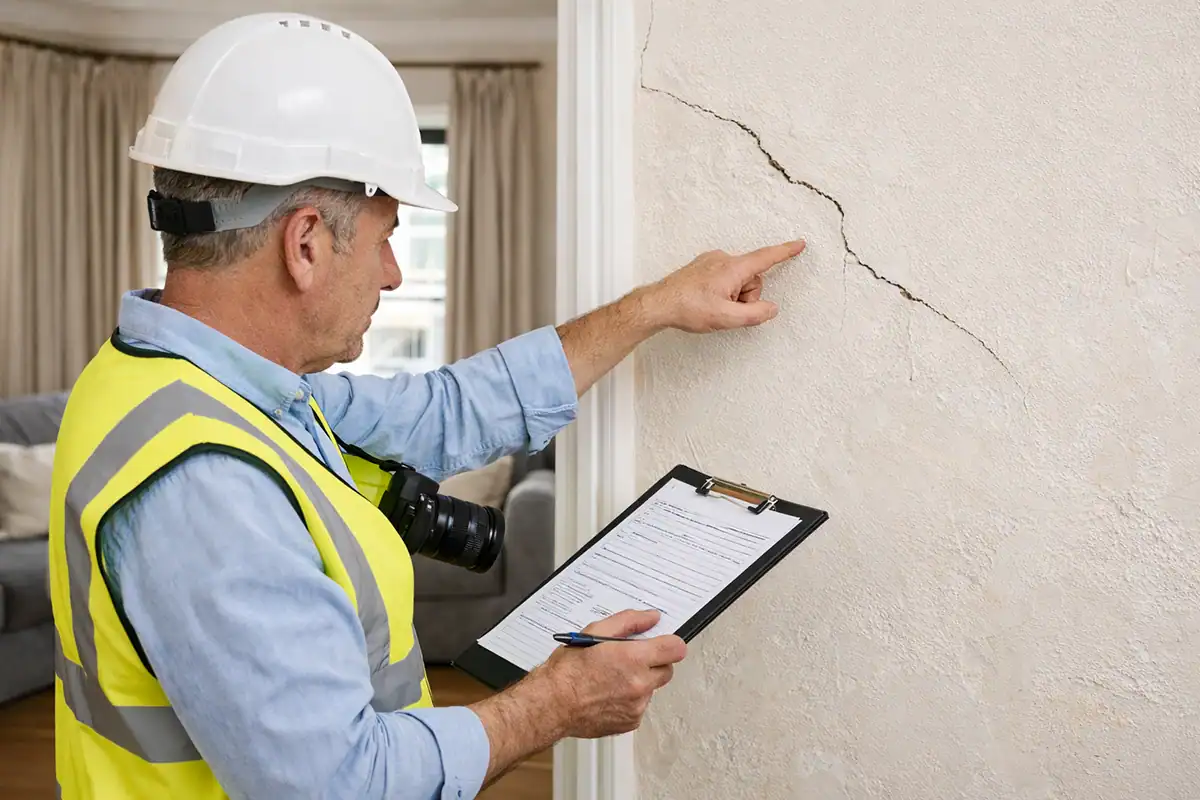
Planning building works next to a neighbour? You need to record the condition of their property before work starts. This is called a schedule of condition. It protects both you and your neighbour and without one, any dispute about damage is very hard to resolve.
This guide covers everything you need to know about schedules of condition in England and Wales. What they are, when you need one, how they work, and who pays.
What is a Party Wall Schedule of Condition?
A schedule of condition is a detailed record of the condition of a property at a specific point in time. It is prepared before any notifiable building works begin. The party wall surveyor visits the neighbouring property, documents what they see, and photographs everything relevant.
It is a statement of fact, not an opinion. The surveyor records existing defects exactly as found. Nothing more, nothing less.
The schedule of condition report usually forms part of the party wall award. It sits within the wider party wall process under the Party Wall etc. Act 1996.
A schedule of condition is not legally required under the Act. But case law places the burden of proof on the building owner. If damage appears after works, you must prove it wasn’t caused by your project. Without a record of the condition of a property beforehand, that proof simply doesn’t exist.
Why is a Schedule of Condition Important for Party Wall Work?
The Party Wall etc. Act 1996 provides a framework for preventing and resolving disputes between property owners and developers in relation to party walls and boundary works. It covers building works in England and Wales that affect party walls, party fence walls, and boundary walls. Under Section 7(2), the building owner must compensate the adjoining owner for any damage caused by the works.
Think about what happens without a schedule. Hairline cracks appear in your neighbour’s ceiling after your loft conversion. Were they there before? Nobody can say for certain. That uncertainty leads to party wall disputes that cost far more to resolve than a schedule would have cost to prepare.
With a schedule of condition in place, the answer is clear. Either the crack is in the photographic evidence taken before works or it isn’t. That one document can resolve a dispute in days rather than months.
Even if your neighbour consents to the proposed works, a schedule is still worth preparing. Consent doesn’t prevent damage from occurring. A clear record of the condition of the property protects both sides equally.
The party wall surveyor is an impartial professional throughout this process. Their job is to protect both parties, not just the one paying their fees.
Generate Your Party Wall Notice in Minutes
Need to serve notice before your project starts? Our free generator creates a legally compliant party wall notice instantly. No solicitor needed.
- 1Answer a few questions
- 2Notice generated automatically
- 3Download and serve your neighbour

How is a Schedule of Condition Carried Out?
Appointment of a Surveyor
The schedule of condition is carried out by the appointed party wall surveyor. Where both parties have their own surveyor, the two surveyors carry out the inspection together. The appointment of a surveyor follows the service of a party wall notice.
Where an agreed surveyor has been appointed, one surveyor acting for both parties, that surveyor prepares the schedule alone. They act impartially throughout. The schedule carries the same weight whether prepared by one or two surveyors.
Inspection of the Property
The surveyor visits the adjoining owner’s property and carries out a visual inspection. It is non-intrusive. No furniture needs moving. No floors need lifting.
The surveyor records walls, ceilings, and floors in all rooms near the proposed works, external walls, brickwork, and boundary structures, gardens and hard landscaping where excavation is planned, and chimney flues or drainage runs where relevant.
Each room is documented with written notes and dated photographs. Existing defects are described clearly. Where works involve excavation or underpinning, the inspection may cover the whole building including lower floors and foundations.
Completion and Circulation
Once complete, the schedule of condition report goes to both the building owner and the adjoining owner. It then forms part of the party wall award. From that point, it is the agreed record of condition before works began. Any reported damage after works is measured against it.
The schedule records what was found on the day of inspection. It cannot record defects that were hidden or not visible at the time of the survey.
The Importance of a Good Schedule of Condition Report
A weak schedule of condition is almost as bad as having none. Missed defects create gaps that are hard to defend later. Poor photographs carry little weight as evidence.
A strong schedule of condition report includes clear, dated, high-resolution photographs of every relevant area, specific written descriptions rather than vague summaries, room-by-room indexing throughout the neighbouring property, full coverage of all areas affected by the proposed works, and the surveyor’s credentials and date of inspection.
Party wall surveying requires precision and nowhere is that more important than in the schedule of condition report.
At AC Design Solution, our party wall surveyors are members of the Institute of Party Wall Surveyors (IPWS). Every schedule we prepare is detailed enough to stand up in a party wall dispute.
Getting this right at the start is always cheaper than fixing a dispute later. See our party wall surveyor fees guide for a full cost breakdown.
When Does the Party Wall Award Include a Schedule of Condition?
The party wall award is the formal legal document that sets out how notifiable works must be carried out. The schedule of condition sits within the wider party wall procedures that govern how notifiable works are managed from start to finish. In most cases, the schedule is appended to the award as a supporting document.
The appointed surveyors agree the scope of the schedule between them. Both sign it before it takes effect. Once it forms part of the award, it carries statutory authority.
Where an agreed surveyor is acting for both parties, they prepare the schedule alone. It carries the same weight as one prepared by two surveyors acting separately.
After works complete, the schedule is the first document the surveyors refer to if any reported damage arises. It forms the basis of any compensation assessment under the Act.
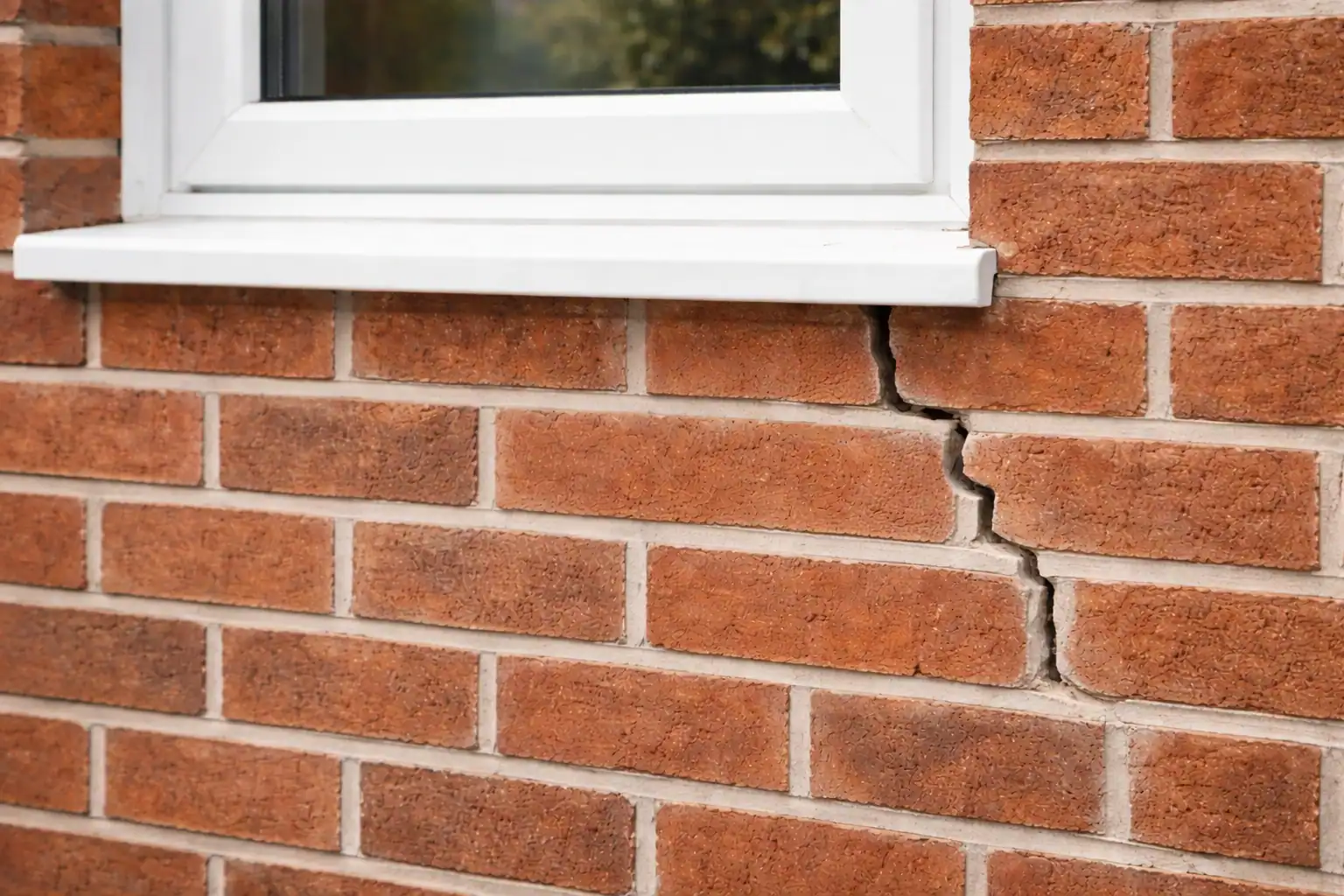
Building Owner and Adjoining Owner: Who Does the Schedule Protect?
The schedule of condition protects both parties but in different ways.
For the building owner, it is a defence. If the adjoining owner claims damage after works, the schedule shows what the condition of the property was before work started. Existing hairline cracks, old defects, and prior movement are all on record. Without it, the building owner has nothing to rely on.
For the adjoining owner, it is a guarantee. Any new damage that appears after works can be compared directly against the pre-works record. If it wasn’t there before, the schedule shows that clearly.
This balance is what the Party Wall etc. Act 1996 was designed to create. It is a statutory system that protects property owners on both sides of a boundary, not just the one carrying out the works.
When Might a Party Wall Agreement or Schedule of Condition be Needed?
A schedule of condition is needed any time notifiable works are being carried out under the Party Wall etc. Act 1996. Common situations include the following.
Rear extensions mean works to a shared wall or within 3 metres of an adjoining property trigger the Act. A party wall notice must be served on all adjoining owners before works begin.
Loft conversions involve structural works to a shared party wall that are notifiable. Read more about party wall agreements for loft conversions.
Basement conversions and underpinning involve excavation within 3 metres of a neighbour’s foundations that is notifiable. This is where the most thorough schedule is needed. See our guide to party wall agreements for basement conversions.
Load-bearing wall removals cover works that are adjacent to or affect the party wall structure.
Excavation means any digging within 3 metres of a neighbouring building, deeper than existing foundations, is notifiable. See our full guide to the party wall act 3 metre rule.
In every one of these cases, the condition of the adjoining owner’s property should be formally recorded before works start.
Excavation Works and the Condition of Adjoining Properties
Excavation is one of the highest-risk situations for adjoining properties. Deep digging, underpinning, and basement construction can all cause settlement and movement in neighbouring buildings, sometimes in ways that aren’t visible straight away.
Under the Act, excavation within 3 metres of a neighbouring building going deeper than its existing foundations is statutory notifiable. Works within 6 metres that meet a 45-degree line from the bottom of a neighbouring foundation are also notifiable.
The condition of adjoining properties at foundation level is harder to assess than surface-level defects. A thorough schedule in excavation cases will cover the full building, not just rooms next to the works. External walls, boundary structures, and any visible signs of existing movement are all documented.
The two surveyors or agreed surveyor will agree the appropriate scope before the inspection takes place. Our guide to party wall agreements for basement conversions explains the full process in more detail.
Party Wall Disputes and the Schedule of Condition
Most party wall matters go smoothly. But when damage is reported after works, the schedule of condition is the document that either settles or escalates the situation.
If the reported damage appears in the schedule as a pre-existing defect, the dispute ends quickly. If it’s new damage, not present in the photographic evidence from before works, the appointed surveyors can assess what remediation is fair and issue a supplementary award if needed.
Without a schedule, a party wall dispute has no objective starting point. Both sides have competing claims and no evidence. That’s when relationships between neighbours break down and legal costs mount.
A good schedule doesn’t prevent all disputes. But it gives both parties and their surveyors the tools to resolve them quickly and at low cost.
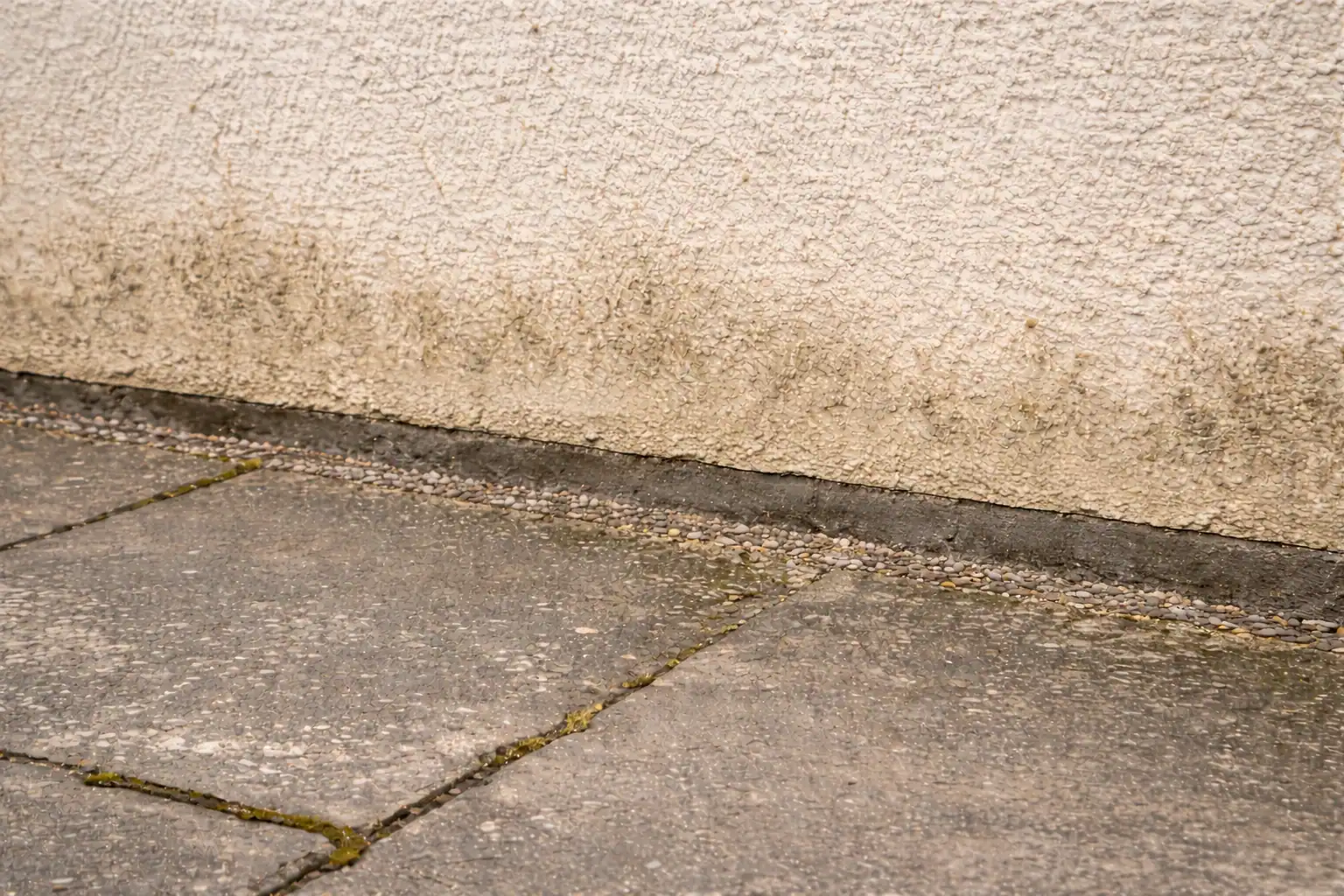
Party Walls Specimen Schedule of Condition
A typical schedule of condition follows this structure.
The cover sheet includes the addresses of both properties, date of inspection, names of appointed surveyors, and scope of the proposed works.
The room by room schedule documents every room individually with written notes and photograph references for walls, ceilings, floors, windows, and doors throughout all areas near the notifiable works.
The external areas section covers the condition of brickwork, render, boundary structures, gardens, and outbuildings within the affected zone.
The photographic schedule contains indexed, dated photographs corresponding to the written schedule. These form the core photographic evidence of the document.
The surveyor sign-off requires both the building owner’s surveyor and the adjoining owner’s surveyor to sign the completed document before it forms part of the award.
The schedule records facts only. It does not give opinions on the cause of defects. It cannot record latent defects that were hidden at the time of inspection.
Advice on Schedules of Condition
Not sure whether you need a schedule of condition? In almost every case involving notifiable works, the answer is yes. Even where the adjoining owner has given written consent, recording the condition for party wall purposes before work starts is simply good practice.
The condition of a building is assessed visually. A professional surveyor knows what to look for and what to record. A professional surveyor knows when and how to prepare a schedule of condition that will hold up if a dispute arises months after works complete. They will spot existing defects an untrained eye would miss. They will document them in a way that holds up long after works are finished.
If you need advice on schedules of condition or any part of the party wall process, AC Design Solution’s surveyors are members of IPWS and FPWS. We cover London, Essex, and the Home Counties. Get in touch or use our party wall cost calculator to find out what’s involved.
Conclusion: Party Wall Schedule of Condition
A schedule of condition is a practical safeguard, not a formality. It protects the building owner from unfair claims. It protects the adjoining owner if their neighbouring property is genuinely damaged. And it gives the appointed surveyors a clear, objective basis for resolving any issue that arises.
The party wall process is designed to be fair to everyone. A thorough schedule of condition, prepared before works begin and filed as part of the party wall award, is one of the most important parts of making it work that way.
AC Design Solution’s party wall surveyors cover London and the surrounding areas. If you’re planning works that affect a shared boundary, use our free party wall notice generator to get started.
Frequently Asked Questions
What is the difference between a schedule of condition and a party wall award?
A party wall award is the formal legal document that sets out how and when works must be carried out. It covers the rights and obligations of both parties. A schedule of condition is a separate document. It records the condition of the adjoining owner’s property before works begin. In most cases it is appended to the award and becomes part of it. The award is the legal framework. The schedule is the evidence base.
Who pays for a schedule of condition?
The building owner pays. Under the Party Wall etc. Act 1996, the building owner is responsible for the costs of the party wall process. This includes the cost of preparing the schedule of condition. Where the adjoining owner appoints their own surveyor, those reasonable fees are also paid by the building owner.
What is the schedule of condition clause?
The schedule of condition clause is the provision within a party wall award that appends the schedule as a formal document. It states that the condition of the adjoining property has been recorded. It sets out that any damage claimed after works must be assessed against that record. This gives the schedule its statutory basis under the Act.
Schedule of condition and the Party Wall Act
The Party Wall etc. Act 1996 does not make a schedule of condition a legal requirement. But it puts the burden of proof on the building owner. You must show that any damage to the adjoining owner’s property was not caused by your works. Published guidance notes on party wall surveying confirm this position and set out the standard expected of a well-prepared schedule. Most experienced party wall surveyors prepare one as standard when issuing a party wall award.
Do I need a party wall agreement for an extension?
If your extension involves works to a shared wall, excavation within 3 metres of a neighbouring building, or building at the boundary line, the Act applies. You must serve a party wall notice on all adjoining owners first. If your neighbour consents, works can proceed. If they dissent or don’t respond, a party wall award is needed. A schedule of condition should be prepared as part of that process.
How is a schedule of condition carried out?
The party wall surveyor visits the adjoining owner’s property before works begin. They carry out a room-by-room visual inspection. They record the condition of walls, ceilings, floors, and external areas through written notes and photographs. The inspection is non-intrusive. No structures are opened up. No floors are lifted. The completed schedule of condition report is sent to both parties and appended to the party wall award as the agreed pre-works record.